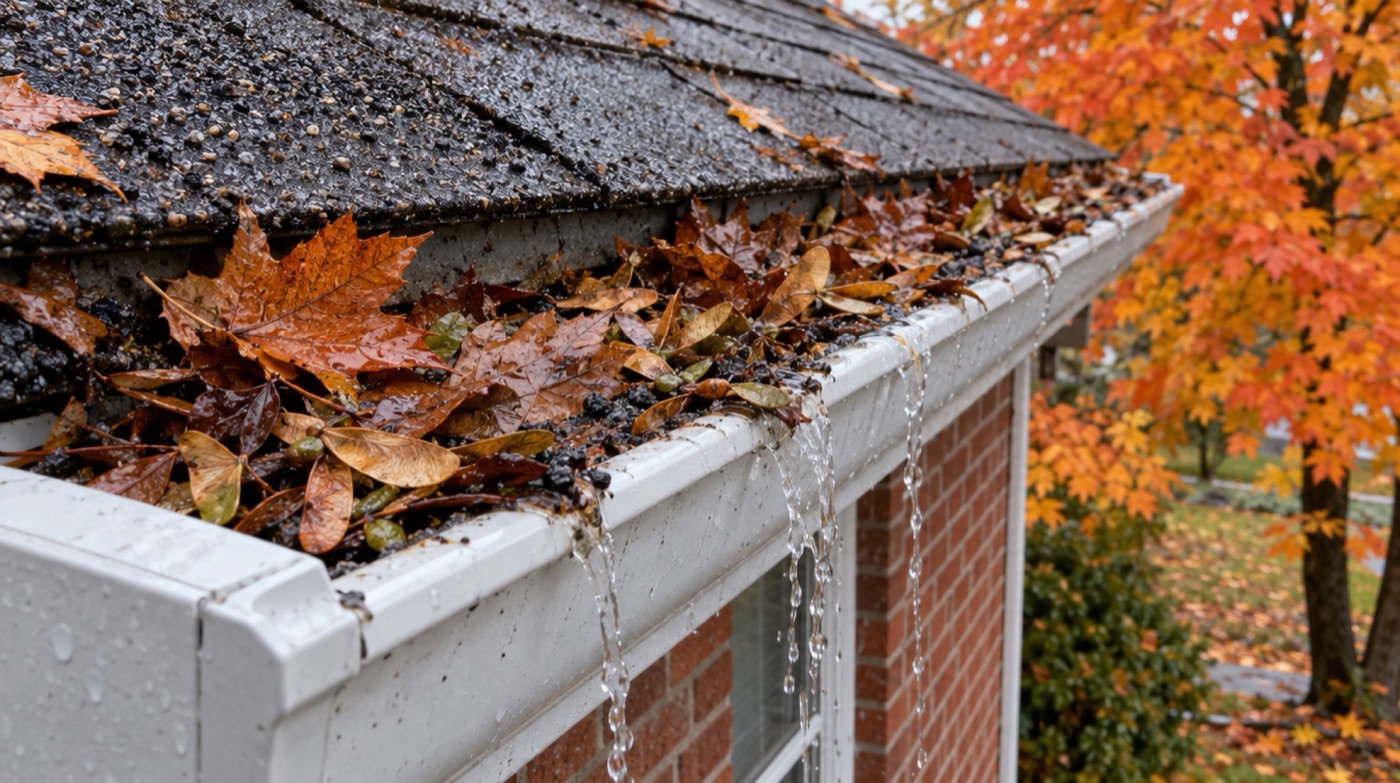
Every fall the same picture plays out across London: maple keys, oak leaves and shingle grit packed into the eavestroughs, a heavy rain, and water pouring over the front lip straight down beside the foundation.
Cleaning them out is one of the most important bits of home maintenance there is. It’s also, traditionally, one of the riskiest, because it means someone on a ladder leaning against the trough, or walking the roof edge.
We do it differently. Our crews clean eavestroughs from the ground, with no ladders and no one on your roof. Here’s why that matters, what our system does, and what we’re checking while we’re there.
Why clean eavestroughs matter: the water math
It’s easy to underestimate how much water a roof collects. The rule of thumb is simple: 1 mm of rain on 1 m² of roof is 1 litre of water.
London’s historical climate normals (1981–2010) average about 846 mm of rain a year, plus about 194 cm of snow.[1] For a bungalow with roughly 140 m² (1,500 sq ft) of roof footprint, that works out to these estimates:


- About 118,000 litres of rain a year landing on the roof. Not every litre reaches the eavestroughs, but it shows how much water the drainage system has to handle
- About 3,500 litres from a 25 mm day of rain. That’s 3.5 tonnes of water, and London averages five or six days a year with 25 mm or more of rain[1]
When the trough is clear, that water goes into the downspout and away from the house. When it’s clogged, it goes over the edge, and the Institute for Catastrophic Loss Reduction’s handbook on basement flooding puts it bluntly: water pours over the side, lands close to the home and runs down the foundation wall, where it can get into window wells and weeping tiles.[2]
Water in the basement is expensive to clean up and often preventable. Clean eavestroughs and properly extended downspouts are one of the cheapest lines of defence against it.
Ice, weight and winter
A clogged trough is also a problem in winter. When debris soaks up water and freezes, the extra weight strains the hangers and fascia. Meltwater coming off the roof has nowhere to go, so it refreezes at the edge and can back up under the shingles. That’s why we push for a cleaning before winter.
It’s worth being precise here: many roof-edge ice dams start with heat escaping into the attic, which melts snow higher on the roof so it refreezes at the colder eaves. Clogged or frozen eavestroughs can make ice buildup and drainage problems worse, but cleaning alone won’t fix an ice dam caused by heat loss.[3]
Why we keep ladders out of it

We’ll say this plainly, without trying to scare anyone: ladder falls are one of the most common serious home injuries in Ontario.
- In 2014/15, ladder falls led to 8,678 emergency department visits and 1,112 hospitalizations in Ontario, across all ages.[4]
- Among adults aged 45 to 64, 67% of those visits with a recorded location happened at home.[4]
- 61% of the visits reported for that age group happened between July and December, which covers yard and eavestrough season.[4]
- Age raises the stakes. In U.S. Consumer Product Safety Commission data for 2022–2023, 31% of seniors treated in emergency departments for ladder falls were admitted to hospital, compared with 17% of adults aged 25 to 64, about 1.8 times as often.[5]
None of those figures are specific to eavestrough cleaning, but they show how often ordinary home ladder work goes wrong.


There’s also the house to think about. A ladder leaning on an aluminum eavestrough can dent or kink it, and walking a roof edge scuffs shingles and loosens granules. Keeping everyone on the ground protects the people and the property.
How our no-ladder system works
Our crews clean the full run of eavestrough from the ground, using a special vacuum and a long, engineered hose that reaches up and into the trough. On a typical two-storey home in London, nobody needs to leave the lawn.


On a visit we:
- Vacuum the leaves, seeds and grit out of the troughs, so the roof can shed water cleanly going into winter
- Keep ladders off your eavestrough and boots off your shingles
From our files: London. On a two-storey home in London, we demonstrated exactly this setup, a special vacuum and an engineered hose run from the ground, on a trough full of the usual fall debris. It’s safer for the crew and safer for the homeowner’s property.

How often should eavestroughs be cleaned?
The standard advice from Canadian utilities is at least twice a year, in spring and fall.[6][7] In London, our recommendation depends on the trees around your home:


- Late fall, after the leaves drop. This is the most important one, because it clears the trough before it freezes.
- Late spring, once the maple keys and seed pods have come down.
- More often if you’re under mature maples, oaks or pines. London isn’t called the Forest City for nothing.
These are guidelines, not rules. Trees, roof shape and how much debris your home collects all change the right schedule.
We’ll recommend a schedule based on what we actually pull out of your troughs on the first visit.
Frequently asked questions
Is it safe to clean gutters yourself?
It carries real fall risk. Ontario recorded 8,678 emergency department visits for ladder falls in 2014/15, and among adults aged 45 to 64 most of those with a recorded location happened at home. That’s the reason we built our service around a system that keeps everyone on the ground.
How often do eavestroughs need cleaning?
At least twice a year, spring and fall, and more often under heavy tree cover.
Do you need to get on my roof?
No. Our system works from the ground, with no ladders against your eavestrough and no one walking on your shingles.
Do you clean eavestroughs on two-storey homes?
Yes. Two-storey homes are routine for our ground-based system.
What areas do you serve?
Eavestrough cleaning in and around London, Ontario.
Book a cleaning before the freeze
We clean eavestroughs in and around London, Ontario, from the ground, with no ladders and no one on your roof. Request a free quote or call 226-378-3252.
Related: Common eavestrough problems · Gutter cleaning service · All gutter services · St. Thomas flat roof leak + eavestrough cleaning
Sources
- Environment and Climate Change Canada, Canadian Climate Normals 1981–2010, London International Airport (Climate ID 6144475): 845.9 mm rainfall, 194.3 cm snowfall, 5.6 days/yr with ≥ 25 mm rain. https://climate.weather.gc.ca/climate_normals/ — roof volumes are our own calculation (1 mm × 1 m² = 1 L).
- Dan Sandink, Handbook for Reducing Basement Flooding, Institute for Catastrophic Loss Reduction (2009), Options 10 and 12. https://citywindsor.ca/Documents/residents/roads-sewers-sidewalks/sewers/Basement%20Flooding%20Handbook.pdf
- Canada Mortgage and Housing Corporation, About Your House: Attic Venting, Attic Moisture, and Ice Dams. https://publications.gc.ca/collections/Collection/NH18-24-13E.pdf
- Parachute, Ontario Injury Compass, Issue 11, December 2015 (ladder falls, 2014/15 CIHI data). https://parachute.ca/wp-content/uploads/2019/06/Ontario-Injury-Compass-December-2015.pdf
- U.S. Consumer Product Safety Commission, Senior Injuries and Deaths Associated with Consumer Products, 2024 Report (January 2025). https://www.cpsc.gov/s3fs-public/Senior-Report-2024-POSTED2.pdf
- EPCOR, “Eavestrough maintenance.” https://epcor.com/products-services/drainage/flooding-flood-prevention/flood-prevention-homeowner-maintenance/Pages/eavestrough-maintenance.aspx
- Halifax Water, “Seasonal maintenance checklist.” https://www.halifaxwater.ca/sites/default/files/2024-02/seasonal_checklist.pdf


